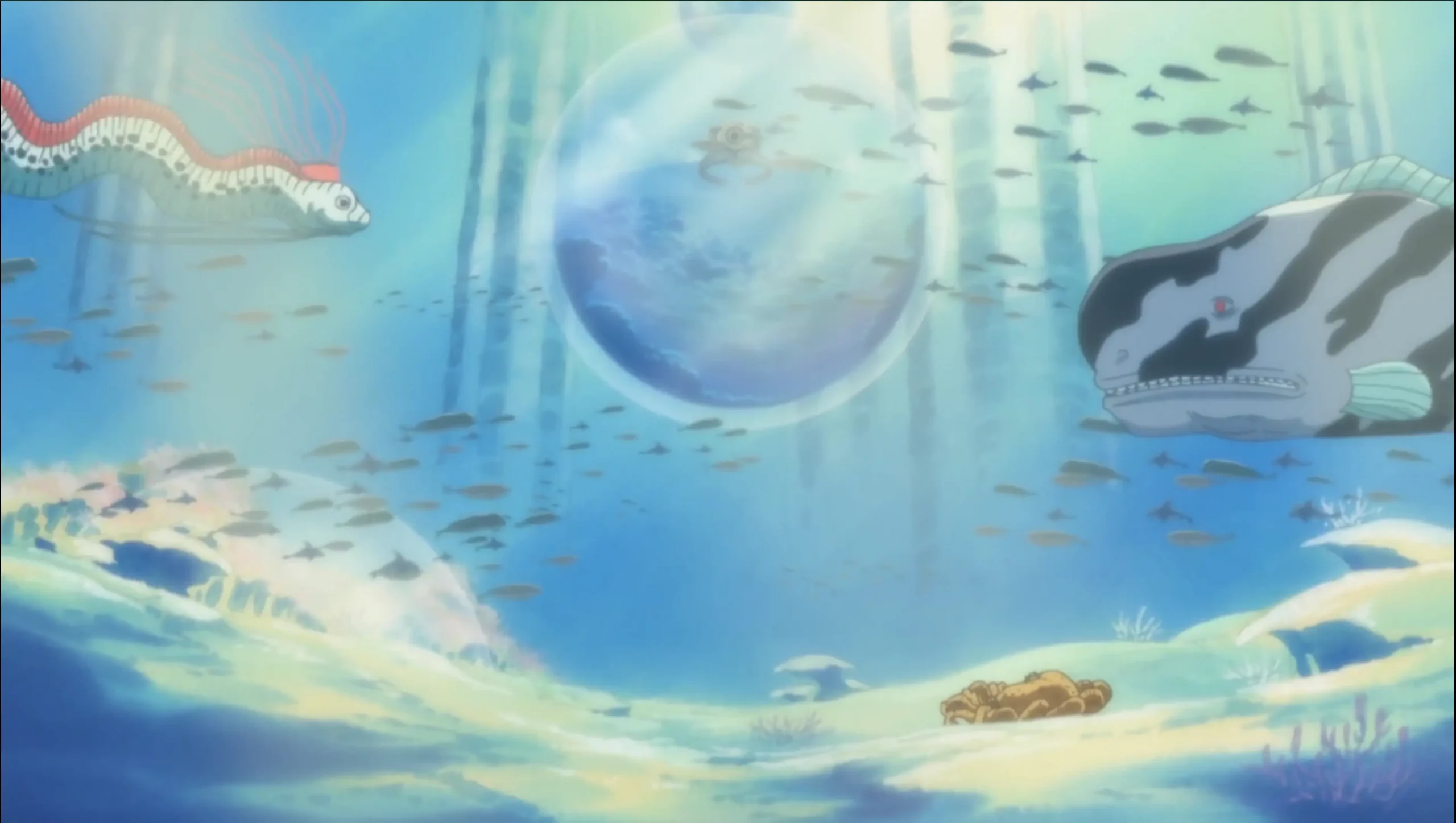
Fishman Island is one of those locations that becomes stranger with every new One Piece revelation. This Fishman Island Theory begins with several questions the story has never completely answered.
Why does the island exist inside an enormous air-filled bubble? How does Sunlight Tree Eve support both its atmosphere and sunlight? And why does Noah—one of the largest ships ever constructed—rest beside a civilization whose people can already survive underwater?
Most importantly, why does Fishman Island sit directly beneath Marijoa, the home of the Celestial Dragons and the center of the World Government?
For years, viewers could treat these details as separate pieces of world-building. Vegapunk’s discoveries about the Void Century changed that.
His broadcast revealed that a man-made catastrophe created the modern world. Continents disappeared, civilizations sank, and the sea rose by 200 meters. Once we place Fishman Island against that forgotten version of the world, its bubble, location, sacred tree, and connection to Joy Boy begin to look far more important.
Together, these details may preserve the history of a civilization the World Government tried to erase.
And that lost civilization may have been Oda’s version of Atlantis.

Because this theory includes major revelations from the Egghead and Elbaph arcs, consider this your spoiler warning.
Welcome to BareAnime. If you enjoy evidence-based theories exploring One Piece’s biggest mysteries, leave a like, subscribe, and share your interpretation in the comments.
Before we can uncover Fishman Island’s secret, we need to understand what Vegapunk discovered beneath the sea.
The Void Century Flood
Vegapunk uncovered the truth by continuing the same forbidden research that led to Ohara’s destruction.
After studying Ohara’s surviving records and deciphering a limited number of Poneglyphs, he reconstructed part of the history that the World Government erased from the Void Century. Vegapunk could not determine what caused the original conflict or declare which side was right. However, he discovered enough to reveal that the modern world rests on a lie.
At the end of Chapter 1113, Vegapunk delivers his warning:
“The world as we know it will sink into the sea.”

Chapter 1114 begins explaining why.
Approximately 900 years ago, Joy Boy came from an ancient kingdom with technology far more advanced than anything found in the present. Recorded history eventually recognized him as the first pirate.
Joy Boy then fought against an alliance of Twenty Kingdoms. After his defeat, those kingdoms formed the World Government, and the history of the conflict disappeared.
Yet the Great Kingdom was not the only thing erased.
The conflict changed the world itself.
The Old World Still Exists
In Chapter 1115, Vegapunk reveals that the world once contained enormous continents that no longer appear on modern maps.
During the Void Century, the sea level rose by approximately 200 meters. Rising water swallowed those continents along with their cities, cultures, and kingdoms.
The islands inhabited today are only fragments of that former world—the highest pieces of land that remained above the ocean.
That means One Piece’s geography is not natural. Dangerous seas separate its isolated islands and divide its populations because of an ancient catastrophe.
The world of 1,000 years ago is still there.
It simply lies underwater.

This revelation is central to the Fishman Island Theory because it changes how we should view every civilization beneath the sea—especially Fishman Island.
Why Does Fishman Island Look Different After the Flood?
Most of the old world became inaccessible ruins. Its cities, cultures, and kingdoms disappeared beneath an environment where ordinary humans could not survive.
Fishman Island is different.
The island exists approximately 10,000 meters beneath the surface inside a massive double-layered bubble. Its atmosphere allows humans and other surface races to breathe, while Sunlight Tree Eve transfers sunlight through its roots and supplies air to the ocean floor through respiration.
Those features make Fishman Island inhabitable, but they also raise an important question.
Why does a civilization where fishmen and merfolk live require an environment specifically capable of sustaining people from the surface?
The bubble allows humans to walk, breathe, build homes, and establish a permanent society at the bottom of the ocean. Rather than resembling a settlement meant only for aquatic races, Fishman Island preserves many of the same conditions found on land.

Only one Fishman Island exists, and this has to be an important detail for a reason.
Despite the number of aquatic races and underwater locations in One Piece, no other civilization possesses this exact combination of transmitted sunlight, breathable air, protective bubbles, and a position directly beneath the Red Line.
Before deciding what that means, we first need to understand where the bubble may have come from.
Did Sunlight Tree Eve Create the Bubble?
The next clue in this Fishman Island Theory may already exist at the Sabaody Archipelago.
Chapter 496 establishes that the Yarukiman Mangroves secrete a special resin from their roots. This resin forms durable bubbles capable of holding air.
People at Sabaody use those bubbles for transportation, buildings, protective equipment, and entertainment. Coating specialists can also surround ships with the resin, allowing them to travel underwater without flooding.
The Thousand Sunny could not have reached Fishman Island without that coating.
Chapter 612 later connects the Yarukiman Mangroves to Sunlight Tree Eve. While King Neptune explains how Eve carries sunlight to the ocean floor, Usopp compares the sacred tree to the “boss” of the mangroves at Sabaody.
That comparison may extend beyond their ability to carry air through their roots.
If Sunlight Tree Eve shares the Yarukiman Mangroves’ resin-producing properties, it may create a much greater version of the same substance. Eve’s resin could have formed—or helped sustain—the enormous bubble surrounding Fishman Island.
The manga has not directly confirmed that connection, so this remains part of the theory. However, the established similarities make it possible.
Yarukiman Mangroves create smaller air-filled bubbles, while Sunlight Tree Eve supplies air and light to the ocean floor. Fishman Island sits among Eve’s roots inside the largest habitable bubble the series has shown.


If the bubble came from Eve, the sacred tree may have allowed an entire civilization to survive beneath the sea.
The next question is why anyone would need a refuge that far underwater.
Ancient Weapons may provide the answer.
The Ancient Weapons Sank the World
Vegapunk does not describe the 200-meter sea-level rise as an ordinary natural disaster.
In Chapter 1115, he explains that the change happened too quickly to result from normal geological or environmental forces. Human actions caused the catastrophe, and the Ancient Weapons produced it during the Void Century.
Those weapons did not disappear when the war ended. Vegapunk confirms that they still exist and warns that they await the moment when they will stir again.
Because the weapons remain operational, he concludes that the war from the Void Century never truly ended.
Chapter 1116 proves his warning is not hypothetical.
Vegapunk reveals that someone stole a fragment of the Mother Flame from his laboratory and used it to activate an Ancient Weapon. Two weeks later, that weapon erased Lulusia, triggering worldwide earthquakes and causing the global sea level to rise by another meter.
This attack reproduced the same type of man-made catastrophe that occurred during the Void Century. Ancient Weapons raised the sea level by 200 meters and submerged the old continents. Eight hundred years later, the World Government used one of those surviving weapons to raise it again.
Vegapunk’s statements confirm that the Ancient Weapons responsible for sinking the old world still exist. Whoever controls them can still activate them. The World Government now possesses the necessary power source and access, giving it the ability to repeat the catastrophe that destroyed the Great Kingdom.
The Fishman Island Theory becomes even more disturbing when we consider where Fishman Island sits.
Is an Ancient Weapon Hidden in Marijoa?
Fishman Island sits directly beneath the Holy Land of Marijoa.
As Vegapunk explains that the Ancient Weapons still exist and that the original war never ended, the broadcast directs attention toward Imu and the World Government’s capital.
The story confirms the government’s involvement in the modern attack. York stole a fragment of the Mother Flame and provided it to the Five Elders. Imu then ordered the destruction of Lulusia.
The manga has not revealed the weapon’s physical location.
Imu could be hiding the Ancient Weapon somewhere within Marijoa. Alternatively, the World Government may keep it elsewhere while controlling it from the Holy Land. The manga has also not officially identified which of the three Ancient Weapons the government used.
However, no one can question the World Government’s access to it.
Eight hundred years after the first flood, the descendants of the Twenty Kingdoms still control the power required to sink the world again.
Fishman Island exists directly beneath them.

This placement may not be a coincidence.
If the Ancient Weapons destroyed the old continents, anyone who survived the catastrophe would have needed somewhere beyond the Twenty Kingdoms’ immediate reach. Survivors would have required protection from the ocean, access to air and sunlight, and a location where an entire population could hide.
Fishman Island possesses every one of those features.
It may not have begun as a permanent underwater kingdom.
Instead, it may have begun as a safehouse.
Fishman Island Theory: Was It a Safehouse?
What if someone designed Fishman Island’s air-filled environment to make the island inhabitable for humans—even if everyone has forgotten its original purpose?
I speculate that Fishman Island did not begin as a permanent underwater civilization. It may have served as a sanctuary for people escaping the Twenty Kingdoms and the destruction spreading across the surface.
When the Ancient Weapons began sinking the old continents, the Great Kingdom’s survivors would have needed somewhere beyond the immediate reach of their enemies. Fishman Island offered air, sunlight, protection from the ocean, and a location hidden 10,000 meters beneath the sea. Its breathable environment also gave humans access to the sanctuary, regardless of which people originally sought refuge there.
They may have planned to remain only until the war ended and they could safely return home.
But that time never came.
Joy Boy lost the war. The Great Kingdom fell, the sea swallowed the old world, and the Twenty Kingdoms formed the World Government.
A temporary refuge may have become a permanent underwater society.
Why Would Fishman Island Need So Much Air?
This leads back to one of the island’s strangest features.
Why would fishmen and merfolk need a massive air-filled bubble surrounding their civilization?
Both races can breathe underwater. Yet Fishman Island preserves an atmosphere that specifically supports humans and other surface dwellers. Its residents walk through towns, live inside buildings, and maintain a society that functions much like one found above the sea.
The bubble protects the island and makes it accessible to visitors, but it does not create an impenetrable barrier that keeps everyone out. Ships with the proper coating can enter through its gateways, while the Straw Hats forced their way through after refusing the New Fish-Man Pirates’ demands.
Its most important purpose may be environmental. If Sunlight Tree Eve produced the resin responsible for the bubble, that substance may have created a habitat for people who could not naturally survive underwater.
But preserving a population beneath the sea would solve only half the problem.
Those people would eventually need a way back to the surface.
That may explain Noah.
Why Would Fishman Island Need Noah?
Noah is one of the largest ships ever introduced in One Piece. The enormous vessel has remained near Fishman Island for centuries, waiting for the “promised time.”
Why would a civilization of fishmen and merfolk need a ship capable of carrying an enormous population across the sea?
They can already breathe and travel underwater. Poseidon can also command the Sea Kings, giving the Mermaid Princess access to creatures powerful enough to move Noah without sails or conventional propulsion.
Noah’s builders may not have intended it to provide ordinary transportation for aquatic people. They may have designed the ship to carry an entire population—including anyone who could not independently survive the journey to the surface.
If Fishman Island began as a temporary sanctuary, Noah could have served as its evacuation vessel. Once Joy Boy defeated the Twenty Kingdoms, Poseidon and the Sea Kings would carry the refugees back to the world above.
This Fishman Island Theory connects Noah, Poseidon, the Great Kingdom, and Fishman Island’s unusual environment through one purpose.
The bubble kept the survivors alive.
Noah would take them home.

Did Elbaph’s Ancestors Build Noah?
My personal headcanon is that the warriors of Elbaph—and possibly the original inhabitants of the first world—constructed Noah.
Its enormous scale immediately suggests builders much larger than ordinary humans. That does not confirm that giants created it, but Elbaph now gives the possibility more support.
Treasure Tree Adam stands at the center of Elbaph. Shipwrights prize its wood for its extraordinary strength and used it to construct legendary ships, including the Oro Jackson and the Thousand Sunny.
If Noah’s builders also used Adam wood, its survival across eight centuries would make sense. However, the manga has not revealed which material they used to construct Noah, so that connection remains speculative.
Chapter 648 provides another unresolved clue. After the Sea Kings prevent Noah from crashing into Fishman Island, they discuss whether anyone can still repair the damaged ship. Although the Sea Kings cannot fix it themselves, they believe an unidentified group may be able to help before the promised time arrives.
The manga has never identified that group. They could be descendants of Noah’s original builders, ancient shipwrights, giants, or another people we have not encountered.
This Elbaph connection adds another layer to the Fishman Island Theory.
Elbaph possesses Treasure Tree Adam, while Fishman Island survives through Sunlight Tree Eve. Adam provides the strongest known wood in the world, while Eve carries sunlight and air beneath the sea.
Noah stands between them as an enormous ancient ship waiting to fulfill Joy Boy’s promise.
Oda may be leaving breadcrumbs connecting Fishman Island, Elbaph, Noah, and the sacred trees Adam and Eve.
But we cannot separate the ship from the apology Joy Boy left behind.
Joy Boy’s Apology
Chapter 649 establishes that Joy Boy made a promise to the Mermaid Princess who possessed Poseidon’s power during the Void Century.
Nico Robin asks King Neptune about the Poneglyph in the Sea Forest. Neptune explains that it contains Joy Boy’s apology for failing to fulfill his side of that promise.
The exact promise remains unknown.
King Neptune also reveals that the people of Fishman Island must protect Noah until the promised time, when everyone will finally learn its true purpose. This connects Noah, Poseidon, and Joy Boy’s apology to the same unfinished plan.
My theory is that Joy Boy promised to defeat the Twenty Kingdoms and use Noah to carry the people sheltering beneath the sea to the surface.
Poseidon would command the Sea Kings, allowing them to pull the enormous ship. Noah would carry the population, while Joy Boy created a world where they could safely return.
However, Joy Boy lost.
The Twenty Kingdoms defeated the Great Kingdom, gained control of the world, and buried the history of the conflict. If its builders intended Fishman Island as a temporary refuge, Joy Boy’s failure left its inhabitants trapped beneath the sea for the next 800 years.
That would give his apology far greater meaning.
Joy Boy did not merely fail to move a ship. He failed to bring an entire population home.

The desire to reach the surface has continued into the present. Queen Otohime dedicated her life to repairing the relationship between humans and Fishman Island’s inhabitants so her people could eventually live beneath the real sun.
Her dream may continue the promise that Joy Boy could not fulfill.
Someone in the present era must complete what he started.
Fishman Island—Remnant of Atlantis
At this point, the Fishman Island Theory leads directly to Atlantis.
Plato describes the legendary island civilization in Timaeus and Critias. He presented Atlantis as a wealthy and powerful naval empire that existed approximately 9,000 years before his time.
The civilization possessed extensive resources, impressive engineering, a massive military, and influence far beyond its borders. Eventually, Atlantis waged war, lost divine favor, and disappeared beneath the sea after catastrophic earthquakes and floods.
I believe Fishman Island houses a surviving remnant of the Great Kingdom—One Piece’s version of Atlantis.
The original civilization may have occupied the land where the Red Line and Marijoa now stand, while Fishman Island served as its sanctuary beneath the surface.
After the Great Kingdom fell, the Twenty Kingdoms may have constructed their new capital directly above its ruins.
That would create one of the darkest examples of symbolism in the entire series.
The self-proclaimed gods of the modern world would live above the civilization they destroyed, while its surviving people remained trapped below them.
How the Great Kingdom Parallels Atlantis
Plato describes Atlantis as a powerful island nation with wealth, influence, and engineering far beyond its rivals.
The Great Kingdom possessed technology so advanced that even Vegapunk struggled to recreate it 800 years later. Twenty Kingdoms also had to unite against Joy Boy and his allies, demonstrating the civilization’s immense power.
Each civilization became involved in a massive war.
According to Plato’s story, Atlantis grew arrogant and attempted to expand its empire. These actions angered the gods and led to its destruction.
One Piece may adapt—or intentionally reverse—that part of the legend.
Vegapunk admits that he does not know which side of the Void Century conflict was morally correct. By erasing the Great Kingdom’s history, the World Government gained complete control over how future generations understood the war.
The Twenty Kingdoms may have portrayed the Great Kingdom as dangerous or wicked to justify destroying it.
After their victory, they claimed divine status for themselves.
In this version of the story, the so-called gods who punished Atlantis would not be divine beings. Instead, the Twenty Kingdoms would take that role before creating the World Government.
The Celestial Dragons still live above the rest of humanity while treating ordinary people as inferior. Their ancestors may have condemned the Great Kingdom for challenging their authority, destroyed it with the Ancient Weapons, and rewritten the conflict as divine punishment.
The Destruction of Atlantis
The strongest parallel comes from how both civilizations disappeared.
In Plato’s account, earthquakes and floods consumed Atlantis and dragged it beneath the sea.
The Great Kingdom experienced a similar fate during the Void Century. Ancient Weapons caused the sea level to rise by 200 meters, drowning the old continents and leaving their civilizations at the bottom of the ocean.
History repeated that sequence when the World Government destroyed Lulusia.
An ancient power struck the island. Worldwide earthquakes followed. Then the sea level rose, and another nation disappeared.
That sequence gives the Atlantis comparison more weight than a general similarity between two lost civilizations.
Both possessed advanced technology and participated in a great war.
Forces posing as gods condemned each civilization.
Ultimately, both disappeared during a catastrophic flood.
In One Piece, the people responsible for the destruction now live directly above Fishman Island.
Therefore, Fishman Island may represent more than an underwater kingdom. It could preserve the surviving sanctuary of One Piece’s Atlantis beneath the people who destroyed it and built their new world on top of its ruins.
Is the Great Kingdom’s Name Atlantis?
The Atlantis connection may even reveal the Great Kingdom’s forgotten name.
Professor Clover attempted to say that name during the Ohara Incident, but the World Government killed him before he could finish. That interruption established that the kingdom’s name carries enough meaning to threaten the government even centuries later.
Oda could simply reveal that name as Atlantis.
However, he may also use a variation such as Atlantia or Atlantica.
Atlantica is especially interesting because Disney’s The Little Mermaid uses it as the name of its underwater kingdom. One Piece also connects its underwater civilization to mermaids, a royal family, a princess with extraordinary power, and a world separated between land and sea.
That does not prove Oda borrowed the name, and the comparison should remain symbolic. Still, a variation of Atlantis would allow him to reference the legendary sunken civilization while giving the Great Kingdom a name unique to One Piece.
Whether Oda chooses Atlantis, Atlantia, Atlantica, or another variation, the narrative purpose would remain the same.
The Great Kingdom’s name could reveal that the World Government never completely erased the world’s most advanced civilization.
Its ruins may still exist beneath Marijoa, while Fishman Island preserves the last surviving piece of its history.
Why This Fishman Island Theory Matters
Vegapunk’s message revealed that the modern islands are only fragments of continents that existed before the Void Century.
The Ancient Weapons sank that world. Eight hundred years later, the World Government used a stolen fragment of the Mother Flame to activate one again.
Fishman Island’s location, its enormous bubble, Sunlight Tree Eve, Noah, and Joy Boy’s apology may all preserve pieces of the same forgotten history.
The bubble may have kept the Great Kingdom’s survivors alive. Noah’s builders may have intended the ship to return them to the surface. Joy Boy’s apology may exist because he failed to complete that mission.
Fishman Island may have served as a sanctuary that protected survivors of the Great Kingdom—the civilization Oda may have modeled after Atlantis.
But that answer creates an even greater mystery.
If Fishman Island sheltered the survivors of the civilization that disappeared during the Void Century, what happened to those people after they escaped beneath the sea?
The Fishman Island origin, the distinction between fishmen and merfolk, Noah’s humanlike purpose, and the apparent absence of fishmen from the Elbaph mural may hide the answer.
Were the Great Kingdom’s survivors already fishmen, or did something happen to them after they disappeared beneath the sea?
What if fishmen were once human?
That is the mystery we will explore next.
Until then, tell me what you think. Could Fishman Island preserve the Great Kingdom’s surviving sanctuary, and could its lost name be Atlantis?
Comment “ATLANTIS” if you believe Oda is connecting these mysteries.
If you enjoyed the theory, leave a like, subscribe to BareAnime, share, and check out the next breakdown when it releases.